
Resonance Ventures’ Thesis on Photonics
November 6, 2026
Moore’s Law is slowing down. AI is speeding up. We think photonics is how the industry closes that gap. We’re looking to invest in founders building the tools, links, and factories that will make it happen.
Photonics applies the physics of light to computing and communications, and its core building block is the photonic integrated circuit (PIC): a microchip that combines components such as waveguides, modulators, and detectors so that photons, rather than electrons, carry and process information. The timing of photonics’ advancements matters because the engine of the semiconductor industry is running out of road. Gordon Moore’s 1965 observation is reaching physical limits on transistor size, electron leakage, and flattening clock speeds. Those bottlenecks are now widely read as signs that the foundations of growth for the semiconductor industry might be coming to an end.
Photonics advocates argue that PICs can fill the gap with higher bandwidth and far lower energy use, and the case is strongest where AI clusters are choking on the copper wiring between chips, with rising power costs, data-centre water use, and the concentration of advanced chipmaking in Taiwan adding pressure to find alternatives. But photonics is still young by comparison. It has to reach silicon’s manufacturing efficiency at scale before it can displace legacy approaches, and much of its headline performance still comes from vendors rather than independent benchmarks.
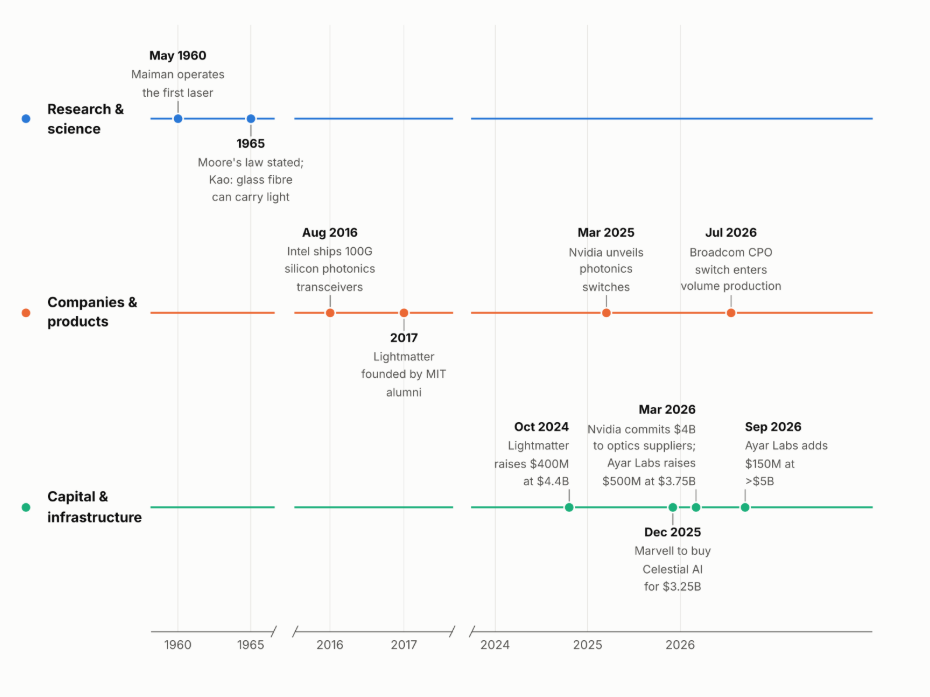
Photonics key milestones, 1960–2026
Capital is moving into photonics because AI has turned the wiring between chips into the bottleneck, and much of it comes from strategic players rather than venture funds alone. Lightmatter was valued at $4.4 billion in October 2024, Ayar Labs went from a $3.75 billion valuation in March 2026 to above $5 billion by September with Nvidia, AMD Ventures, and MediaTek among its backers. Marvell agreed to pay $3.25 billion upfront for Celestial AI, and Nvidia reportedly committed $4 billion across optics suppliers, including $2 billion in Lumentum. However, these valuations are priced on forecasts rather than revenue as even Marvell expects meaningful Celestial AI revenue from only the second half of its fiscal 2028, and Ayar Labs’ CEO says the company must be qualified for volume production by the end of 2027 to meet customer ramps in 2028–2029. Closer to us, Femtum, based in Québec City, raised $16M CAD in 2026 and many of Canada’s finest quantum companies have been big drivers of the photonics space (like Xanadu).